
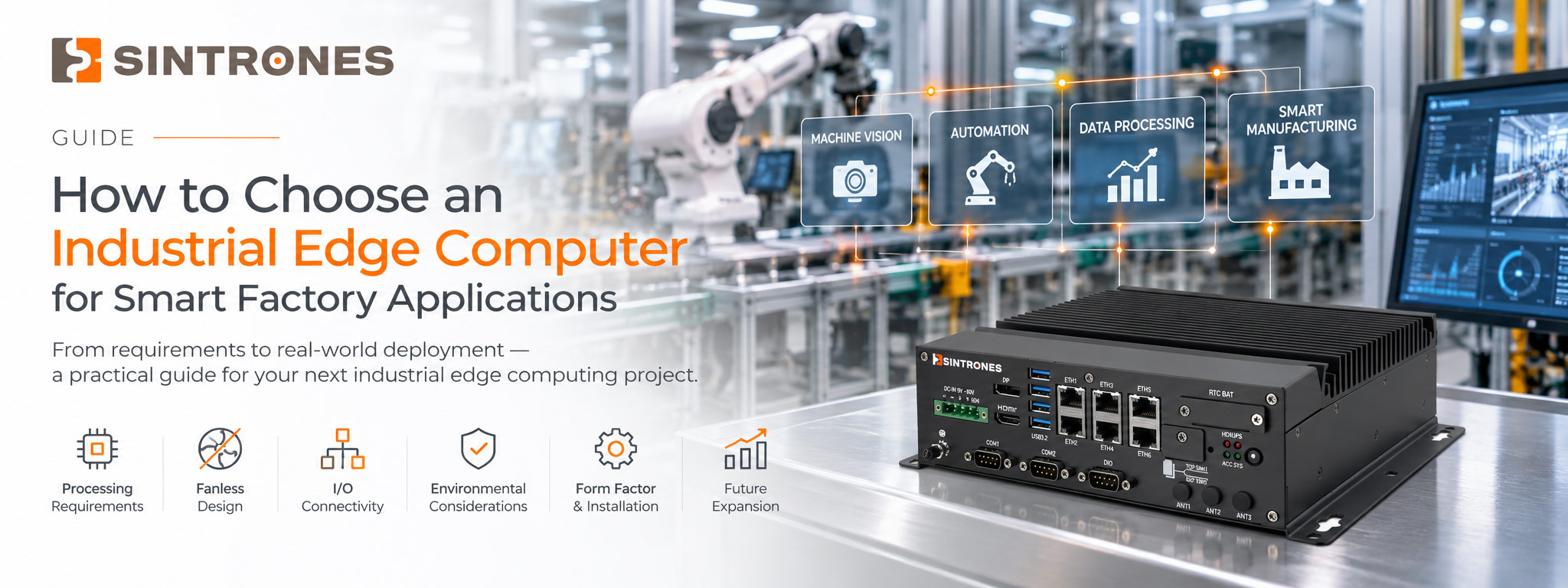
How to Choose an Industrial Edge Computer for Smart Factory Applications
Smart factories increasingly rely on connected machines, sensors, vision systems, and automation equipment to collect and process data directly on the factory floor. As these applications become more sophisticated, choosing the right industrial edge computer becomes an important part of building a reliable and scalable system.
Unlike conventional office computers, industrial edge computers are designed for continuous operation and integration with industrial equipment. Selecting the right platform requires more than comparing processor performance. Environmental conditions, connectivity, installation space, and application requirements should all be considered. For a practical view of these workloads, see SINTRONCORP's industrial edge computing overview for smart factory applications.
1. Start with the Application and Processing Requirements
The first step is to understand what the edge computer will actually do.
Smart factory workloads can range from equipment monitoring and data collection to machine vision, automated inspection, and real-time control. Each application may require a different balance of CPU performance, memory, storage, and expansion capability.
Before selecting a system, consider:
- What data needs to be processed locally?
- How many devices or sensors will connect to the system?
- Does the application involve image or video processing?
- Is real-time or low-latency processing important?
- Will the workload grow or change in the future?
Defining these requirements early helps avoid both an underpowered system and unnecessary hardware complexity.
2. Consider Fanless Operation for Industrial Environments
Factory environments can contain dust and airborne particles that make conventional fan-cooled computers less desirable for certain installations.
A fanless computer eliminates the cooling fan as a moving component and typically uses the system chassis to dissipate heat. This approach can help reduce maintenance requirements while supporting reliable operation in industrial environments.
Fanless design can be particularly useful for systems installed near production equipment, inside control cabinets, or in locations where routine maintenance access is limited.
3. Evaluate the I/O You Actually Need
Connectivity is one of the most important considerations when choosing an industrial edge computer.
Smart factory systems may need to communicate with cameras, PLCs, sensors, controllers, displays, storage devices, and existing network infrastructure. Depending on the application, required interfaces may include Ethernet, serial communication, USB, digital I/O, display outputs, and expansion interfaces.
Rather than simply choosing the system with the largest number of ports, identify the interfaces required by the actual deployment. For example, the ABOX-5222P shown in this article's hero image is one available platform for deployments that need a high-performance industrial edge computer; its product page provides the verified configuration details.
The right I/O configuration can simplify integration and reduce the need for additional adapters or external devices.
4. Match the Computer to the Operating Environment
Industrial computers are often deployed in conditions very different from an office or data center.
Temperature, dust, vibration, installation location, and available power should therefore be considered during system selection.
For more demanding deployments, additional requirements may include wider operating temperature ranges, ruggedized construction, specialized power input, or enhanced environmental protection. SINTRONCORP's rugged industrial computer category provides a starting point for comparing relevant platform types.
The required level of ruggedness should always be determined by the actual operating environment rather than selected solely from a specification checklist.
5. Consider Form Factor and Installation
Factory space is often limited, particularly when a computer needs to be integrated into existing machinery or installed inside an enclosure.
Before choosing a platform, consider:
- Available installation space
- Mounting requirements
- Cable routing
- Access to connectors
- Airflow around the system
- Future service and maintenance access
A compact computer can provide more installation flexibility, but system size should be evaluated together with performance, connectivity, thermal design, and expansion requirements.
6. Plan for Integration and Future Expansion
A smart factory deployment rarely remains unchanged throughout its entire operating life.
Additional cameras, sensors, network connections, storage, or communication devices may be introduced as production requirements evolve. Choosing an edge computer with appropriate expansion capability can make future upgrades easier.
At the same time, excessive expansion capability can increase system size and complexity. The goal is to select a platform that supports both current requirements and realistic future needs.
Choosing the Right Industrial Edge Computing Platform
There is no single industrial edge computer that is ideal for every smart factory application.
The best choice depends on the workload, operating environment, required interfaces, installation constraints, and expected system lifecycle.
By evaluating these factors together, system integrators and manufacturers can select an industrial edge computing platform that fits the actual deployment instead of relying on processor specifications alone.
SINTRONCORP provides industrial edge computing solutions designed for a range of automation, machine vision, equipment monitoring, and smart factory applications.
Explore SINTRONCORP industrial computing solutions to find a platform that matches your deployment requirements.
